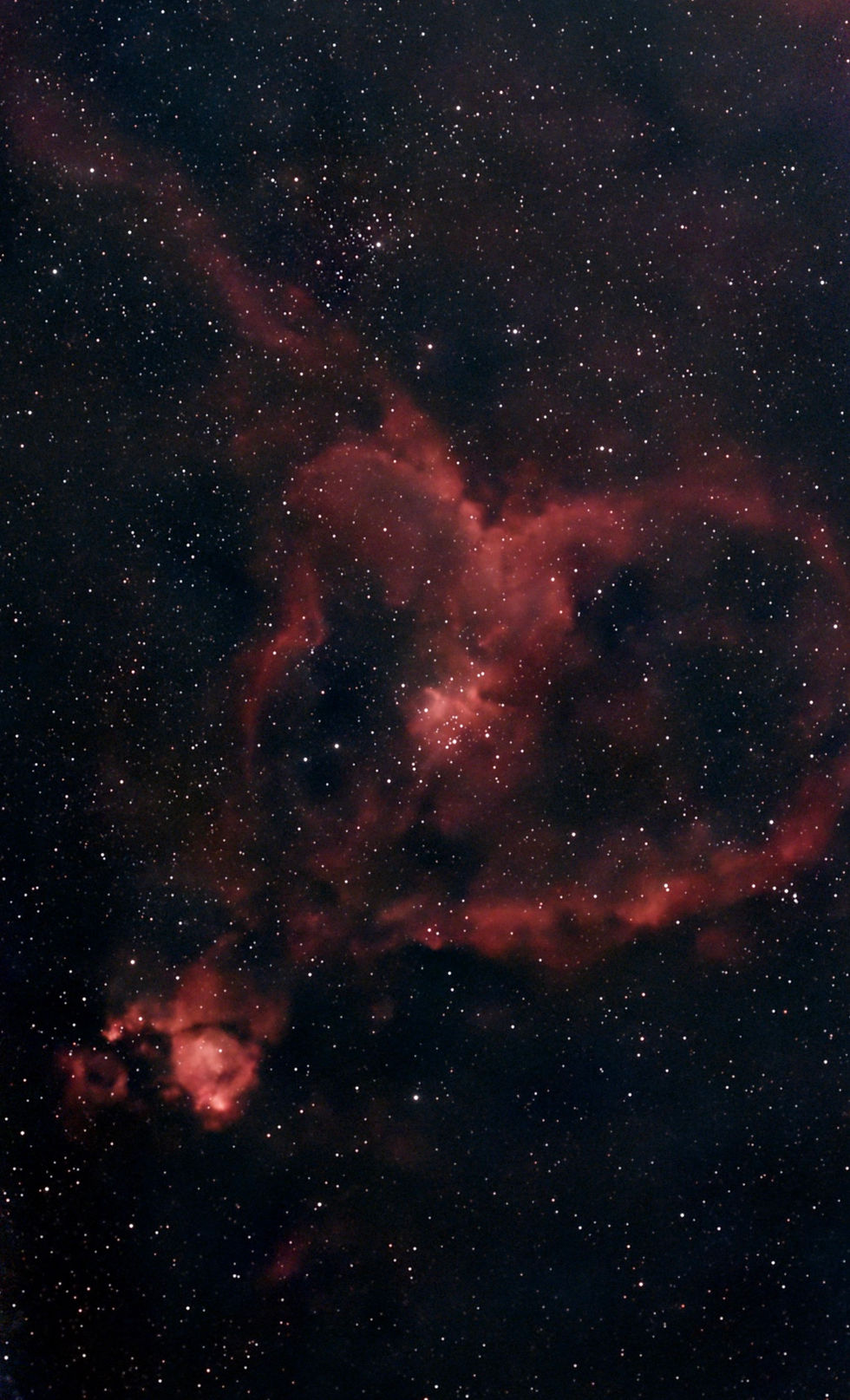
Veil Nebula
#Caldwell33 and #Caldwell34, #NGC6992 and #NGC6960, #PMC45
About this object
The Veil Nebula (Caldwell 33 and Caldwell 34) is a vast supernova remnant located approximately 2,400 light-years away in the constellation Cygnus. This intricate network of glowing filaments represents the expanding debris of a massive star that exploded thousands of years ago, creating a complex structure of interstellar gas and shock-heated material. The nebula is commonly divided into two main regions: the Eastern Veil Nebula (NGC 6992/6995, Caldwell 33) and the Western Veil Nebula (NGC 6960, Caldwell 34), which together form part of the larger Cygnus Loop. The shock waves from the ancient supernova continue to sweep through the surrounding interstellar medium, heating and ionising gas and producing the delicate red, green and blue filaments seen in astrophotography. First identified by William Herschel in 1784, the Veil Nebula provides astronomers with an exceptional opportunity to study the evolution of supernova remnants, the interaction between stellar explosions and the interstellar medium, and the recycling of material from dying stars. Observations across visible, ultraviolet, X-ray and radio wavelengths reveal its complex shock fronts and changing physical conditions. Despite its large apparent size and intricate detail in long-exposure images, the nebula's faint light makes it challenging to observe visually without dark skies, appropriate filters and suitable equipment.
An intriguing recent development emerged in June 2026, when a remarkably thin, straight filament was reported in deep astrophotography of the Eastern Veil. Visible in hydrogen-alpha emission but apparently lacking a corresponding signal in ionised sulfur, the feature was estimated to be only about 1,200 astronomical units wide if it lies at the nebula's distance. Researchers suggested that it could be a shock front from the original supernova interacting with a thin sheet of interstellar material or a magnetic structure viewed nearly edge-on, although its origin remains uncertain. This discovery highlights how deep imaging by amateur astronomers can reveal previously overlooked structures even within well-studied cosmic remnants.
Designations
Standardized Catalogues
Caldwell 33, Caldwell 34
PMC Observatory Catalogue
Observations
2026-10-27 at around 10:00 pm (+00:00)
Location in the sky
The Veil Nebula is located in the Cygnus constellation. The nearest brightest stars are Zeta and Epsilon Cygni.
Photographs
LHS: Caldwell 33, or the Eastern Veil. RHS: Caldwell 34, or the Western Veil. Both captured on the night of October 27, 2026 from Greenwich, London with Seestar S30 Pro.