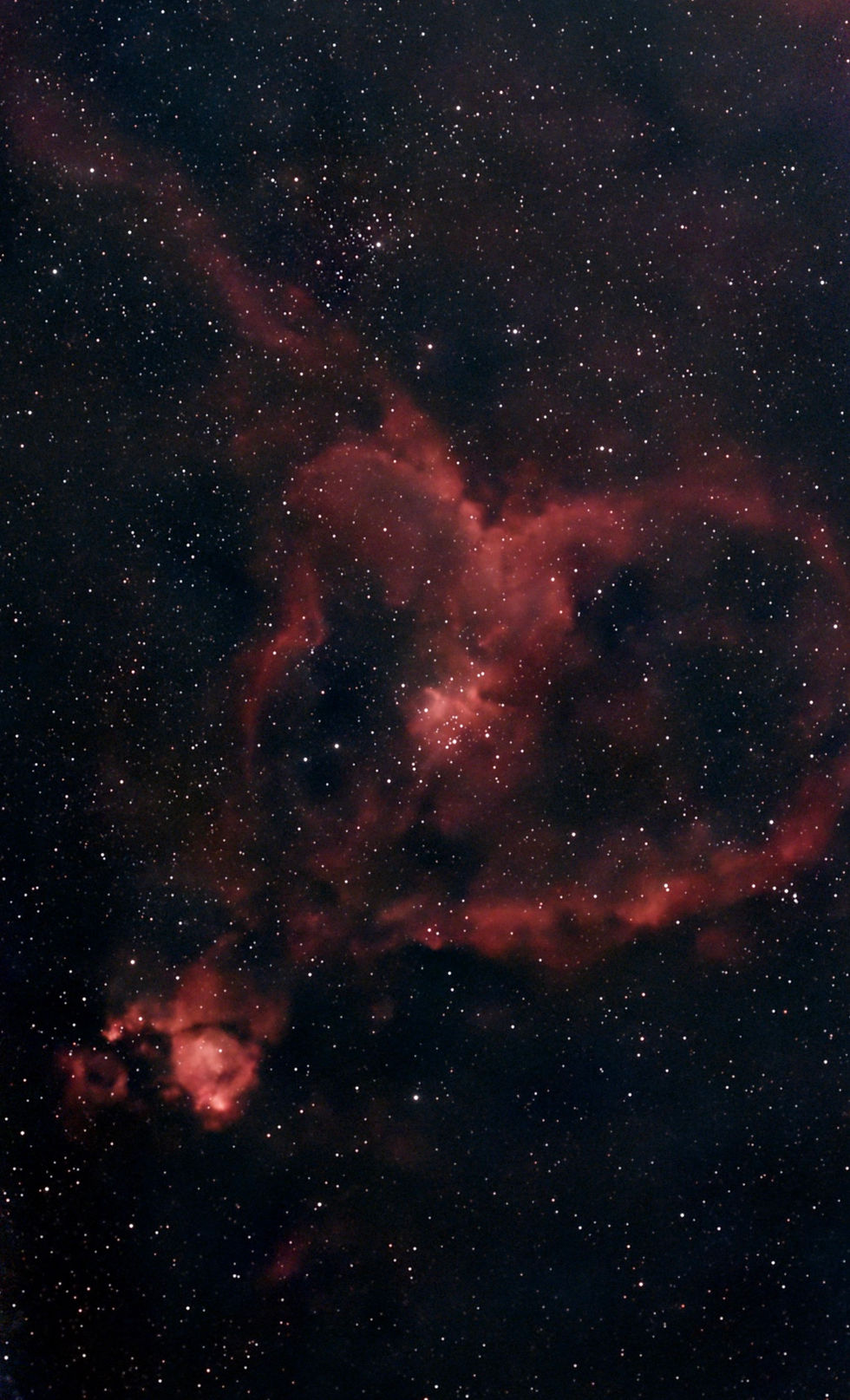
North America Nebula
#NGC7000, #Caldwell20, and #PMC44
About this object
The North America Nebula (NGC 7000), also known as Caldwell 20, is a vast emission nebula located approximately 2,000 light-years away in the constellation Cygnus. Its distinctive shape resembles the continent of North America, with dark lanes of interstellar dust defining its familiar outline against the glowing background of ionised hydrogen. First recorded by William Herschel in 1786, the nebula forms part of a much larger complex of gas and dust that includes the neighbouring Pelican Nebula (IC 5070). Energetic radiation from nearby hot stars causes the surrounding gas to glow, revealing a region of active stellar formation and complex interstellar structure. Modern observations across visible, infrared and radio wavelengths allow astronomers to investigate its dust clouds, ionised gas and young stellar populations, providing insight into how massive stars influence their surrounding environments. Despite its apparent brightness in astrophotography, the nebula's light is spread across a large area, making it challenging to observe visually without dark skies and suitable equipment.
Designations
Standardized Catalogues
Caldwell 20
PMC Observatory Catalogue
Observations
2026-10-25 at around 8:00 pm (+00:00)
Location in the sky
The North America Nebula lies in the constellation Cygnus, close to Deneb, the bright star marking the Swan's tail and one of the vertices of the Summer Triangle. It is situated along the rich star fields of the Milky Way, approximately east of Deneb. Its large angular extent makes it well suited to wide-field binoculars, telescopes and astrophotography, although its low surface brightness can make visual observation difficult under light-polluted skies. Its best position for observation is during evenings in the autumn for the Northern Hemisphere residents.
Photographs