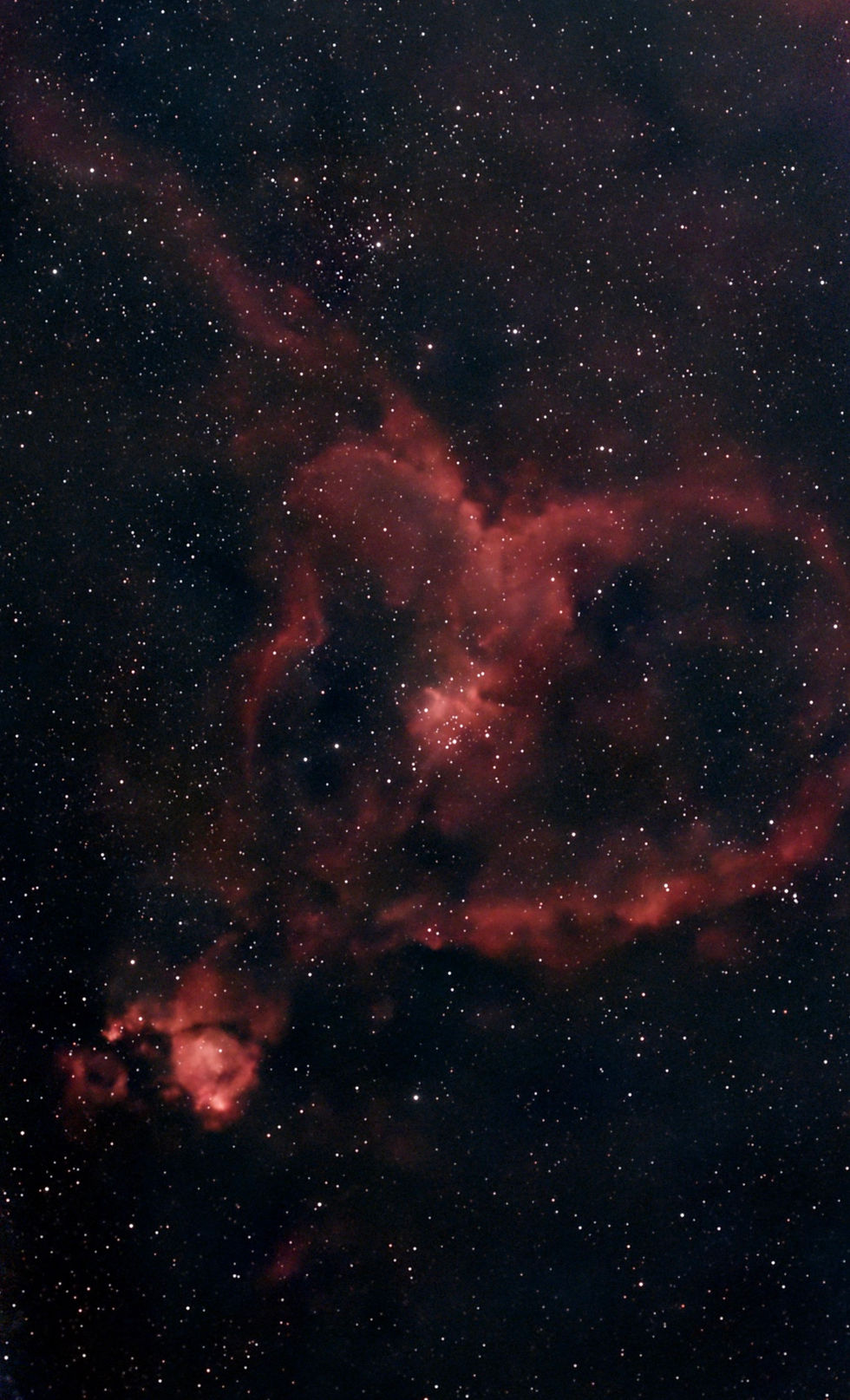
Ring Nebula
#Messier57, #NGC6720, and #PMC43
About this object
The Ring Nebula, catalogued as Messier 57, is one of the night sky's most celebrated planetary nebulae and a favorite target for backyard astronomers. Located approximately 2,300 light-years away in the constellation Lyra, this cosmic smoke ring represents the final gasp of a dying Sun-like star. What appears as a glowing oval or doughnut through most telescopes is actually a barrel-shaped shell of ionized gas expelled by a white dwarf star at its center. The nebula's distinctive ring shape emerges because we're viewing this cylindrical structure from an angle, looking through more material at the edges than through the thinner central region. First discovered by French astronomer Antoine Darquier de Pellepoix in 1779, M57 shines at magnitude 8.8 and spans roughly one arcminute across—about the same apparent size as Jupiter at opposition. Even modest 4-inch telescopes can reveal its characteristic oval form, while larger instruments and OLED filters begin to tease out the subtle blue-green hues of doubly-ionized oxygen and the reddish tones of hydrogen and nitrogen emission. The central white dwarf, though challenging to observe visually, burns at a scorching 100,000 Kelvin and will continue to illuminate this ethereal structure for thousands of years before the nebula gradually disperses into the interstellar medium.
Designations
Standardized Catalogues
PMC Observatory Catalogues
Observations
2025-09-30 at around 09:30 pm +01:00
Photographs