Heart Nebula
About this object
The Heart Nebula (IC 1805), also known as Sharpless 2-190, is a vast emission nebula located approximately 7,500 light-years away in the constellation Cassiopeia. Its distinctive heart-shaped outline is formed by an expansive region of glowing gas and dark interstellar dust, making it a popular target for astrophotography. The nebula spans hundreds of light-years and forms part of a much larger complex of gas, dust and young stars in the Perseus Arm of the Milky Way. Near its centre lies the young open star cluster Melotte 15, whose massive, hot stars emit intense ultraviolet radiation and powerful stellar winds that energise the surrounding hydrogen, causing it to glow predominantly red. These stellar winds also sculpt the surrounding dust clouds into dramatic pillars and cavities, illustrating the powerful influence that young, massive stars have on their birth environments. The nearby Fish Head Nebula forms part of the same broader star-forming region, while the neighbouring Soul Nebula (IC 1848) creates a striking pair with the Heart Nebula in wide-field astronomical images.
Observations across visible, infrared, radio and other wavelengths help astronomers investigate the distribution of gas and dust, the formation of new stars, and the interaction between stellar feedback and the surrounding interstellar medium. Despite its impressive size and vivid appearance in long-exposure images, the Heart Nebula has a low surface brightness, making it difficult to observe visually without dark skies and suitable equipment.
An interesting aspect of the Heart Nebula is that its central star cluster, Melotte 15, is estimated to be only around 1.5 million years old, making it extremely young on astronomical timescales. Some of its most massive stars are nearly 50 times the mass of the Sun, and their intense radiation is simultaneously dispersing the clouds from which they formed and shaping conditions in which further stars may develop. NASA imagery also highlights evidence of a remarkable stellar history in this region: a microquasar associated with the cluster is thought to have been expelled millions of years ago. The nebula therefore offers a vivid example of how star formation, stellar evolution and the movement of energetic objects can shape the structure of our galaxy.
Designations
Standardized Catalogues
IC 1805
Sharpless 2-190
PMC Observatory Catalogue
Observations
2026-10-27 at around 11:00 pm (+00:00)
Location in the sky
The Heart Nebula (IC 1805) is located in the constellation Cassiopeia, in the northern sky, approximately 7,500 light-years from Earth. It lies close to the Soul Nebula (IC 1848), with the two forming a prominent pair of emission nebulae in the Perseus Arm of the Milky Way. Cassiopeia’s distinctive W-shaped pattern makes the region relatively easy to locate, particularly in autumn and winter in the Northern Hemisphere, when the constellation is high in the evening sky. The Heart Nebula lies near the border of Cassiopeia and Perseus and is best photographed with a wide-field telescope or telephoto lens under dark skies.
Photographs
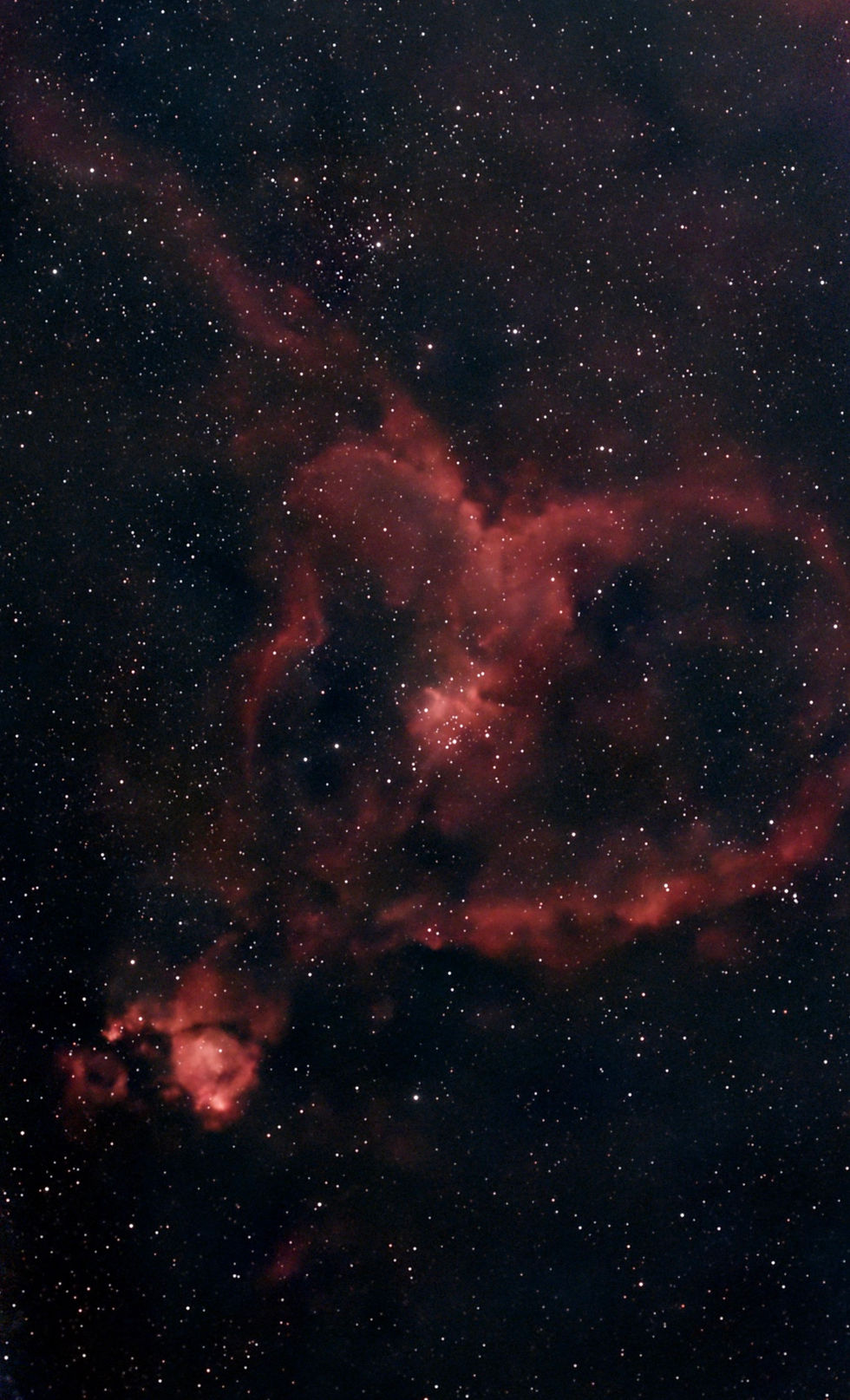
The Heart Nebula pictured on the night of October 27, 2026 from Greenwich, London using the Seestar S30 Pro.


